Why Pretending to Be Normal Drains You With ADHD
You've been hiding your ADHD symptoms for years and you're burned out. Here's why masking drains you and how to unmask safely without falling apart.


ADHD Masking: Why Hiding Your ADHD is So Exhausting (And How to Stop Without Falling Apart)
Listen to this post
Hit play and do your thing. Ara reads it to you.
I spent 28 years performing the role of "person who has it together" and honestly? I deserve an Oscar.
I laughed at jokes I didn't hear because I zoned out mid-conversation. I set 47 alarms so I'd never be late. I rehearsed small talk in my head before every social interaction like I was preparing for a job interview. I hid my fidgeting under tables, forced myself to make eye contact until my brain screamed, and spent every Sunday panic-organizing my life so nobody would know I'd lost three important emails that week.
And I had no idea I was doing it.
That's ADHD masking. It's the exhausting, invisible labor of hiding your ADHD symptoms so the world sees you as "normal." And if you're reading this feeling like someone just described your entire life? You're not alone. You're not broken. You're just really, really tired.

What ADHD Masking Actually Looks Like
Masking isn't just "acting normal." It's a full-time job you never applied for and don't get paid to do.
It's forcing yourself to sit still in meetings when your body is screaming to move. It's laughing along when you missed the last three minutes of conversation because your brain wandered. It's saying "yeah, I'm fine!" when someone asks why you're quiet, even though you're actually drowning in overwhelm and can't find words.
According to research on camouflaging in ADHD, people with ADHD (especially women and people assigned female at birth) develop incredibly sophisticated strategies to hide their symptoms. We become experts at reading rooms, mimicking social scripts, and white-knuckling our way through situations that feel impossible.
Here's what masking actually looks like in daily life:
Social masking: Rehearsing conversations before they happen. Forcing eye contact even though it feels physically uncomfortable. Pretending you heard what someone said when you absolutely did not.
Organizational masking: Setting excessive alarms and reminders so you never forget anything important. Spending hours color-coding planners you'll abandon in three days. Over-preparing for everything because you're terrified of looking scattered.
Emotional masking: Hiding your excitement so you don't seem "too much." Downplaying your struggles so people think you're coping. Forcing yourself to stay calm when your nervous system is in full meltdown mode.
Physical masking: Sitting on your hands to stop fidgeting. Forcing yourself to stay seated when your body needs to move. Hiding stims (like picking at your skin or bouncing your leg) because you learned they're "inappropriate."
The worst part? Most of us don't even realize we're doing it. We just think this is what life costs.
Why Masking Feels Like Wearing a Costume You Can't Take Off
Here's the thing about masking. It works. That's the problem.
When you mask well enough, people don't see your ADHD. They see someone who's "got it together," someone who's "so organized," someone who's "just a little quirky." And for a while, that feels safer than being seen as the person who forgot three appointments in one week or can't follow a conversation to save their life.
But ADDitude on ADHD masking in women points out something critical. Masking doesn't make your ADHD go away. It just makes it invisible to everyone else while you're still dealing with 100% of the struggle internally.
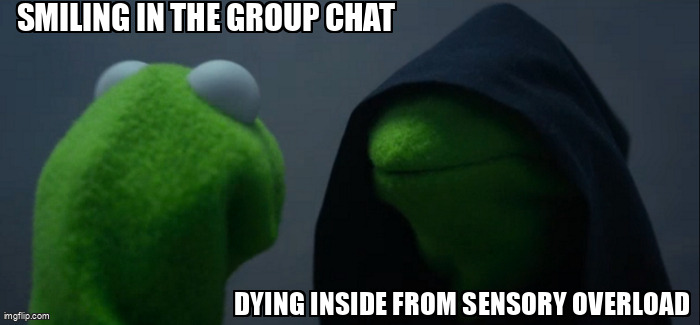
You're still forgetting things. You're just setting 12 alarms to compensate. You're still overwhelmed in loud spaces. You're just forcing a smile and pretending you're fine. You're still struggling with RSD and fear of judgment. You're just getting really good at never showing it.
And that gap between what people see and what you're actually experiencing? That's where the burnout lives.
I used to come home from work and collapse on the couch, completely non-verbal, too exhausted to even scroll my phone. I thought I was just "tired from work." Turns out, I was tired from spending eight hours pretending to be someone I wasn't.
Why Women Mask More (And Pay a Higher Price)
If you're a woman or were raised as one, your masking probably started young. And it probably started because someone told you that your natural way of being was "too much."
Too loud. Too distracted. Too emotional. Too messy. Too forgetful. Too sensitive.
So you learned to be less. You learned to shrink yourself into a shape that felt acceptable. You learned to perform "normal" so well that nobody, including you, realized you had ADHD.
This is part of why women get diagnosed late, often not until their 30s, 40s, or later. We're socialized to be people-pleasers, to read social cues obsessively, to manage everyone else's emotions. Those are the exact skills that make masking invisible.
Dr. Michelle Frank on ADHD masking explains that this kind of chronic camouflaging leads to serious mental health consequences. Anxiety. Depression. Burnout. Identity confusion. And a deep, bone-tired exhaustion that no amount of sleep fixes.
Because here's what nobody tells you about masking. The better you are at it, the more invisible your struggle becomes. And the more invisible your struggle, the less support you get.
People think you're fine. So you don't ask for help. So you keep masking. So you get more burned out. So you mask harder to hide the burnout.
It's a trap. And it's not your fault you're in it.
What Happens When You're Too Tired to Mask Anymore
There's a moment a lot of us hit where the mask just.. cracks.
Maybe it's a burnout so severe you can't get out of bed. Maybe it's a meltdown at work that you can't hide anymore. Maybe it's the realization that you've been performing "normal" for so long that you don't even know who you are underneath it.
For me, it was all three at once.
I hit a wall where I physically could not keep pretending anymore. I started crying in meetings. I stopped answering texts. I couldn't force myself to make eye contact or sit still or do any of the things I'd been white-knuckling my way through for decades.
And I thought I was falling apart.
Turns out, I wasn't falling apart. I was finally stopping the thing that was breaking me.
When the mask cracks, it feels like failure. But it's actually the first step toward finding safe spaces to be yourself. Because you can't unmask safely until you admit that masking was hurting you in the first place.

How to Unmask Without Completely Losing It
Okay, so masking is exhausting and unsustainable. Cool. So what do you do? Just.. stop pretending and hope for the best?
Not exactly.
Unmasking isn't about suddenly revealing every ADHD struggle to every person in your life. It's about finding safe spaces where you can slowly, carefully take the mask off without punishment.
Here's what actually helps:
Start small and private. You don't have to unmask everywhere at once. Pick one safe space. One trusted friend. One low-stakes environment where you can stim, zone out, or say "wait, I didn't catch that" without judgment.
Name what you're doing. "I'm working on unmasking my ADHD" is a sentence that helps you recognize this as intentional growth, not just "getting worse at hiding."
Give yourself permission to be "too much." Your excitement isn't annoying. Your need to move isn't disruptive. Your questions aren't stupid. Those are just ADHD traits you learned to suppress.
Find your people. Unmasking is 1000x easier when you're around people who don't require a performance. That's literally why I started The ADHD Nest community. We have camera-off co-working sessions. We stim openly. We say "I zoned out, can you repeat that?" without shame. It's the first place I ever felt like I could just.. exist.
I also pour a lot of this into my YouTube channel, where I try to show up as my actual ADHD self, not a curated version. Some videos I'm articulate. Some videos I'm a disaster. Both are real.
Recognize that unmasking is grief work. You're mourning all the years you spent hiding. You're mourning the person you could have been if you hadn't been performing. That's heavy. Be gentle with yourself.
You don't owe everyone access to the unmasked you. Some spaces aren't safe. Some people won't get it. That's okay. You can mask strategically in unsafe spaces while building a life where you mask less overall.
Unmasking isn't a light switch. It's a slow, messy process of learning who you are when you're not trying to be someone else.
The Part Nobody Talks About: Unmasking is Weird
Here's what they don't tell you about unmasking.
When you stop performing "normal," you might not know what your actual normal is.
I stopped forcing eye contact and then had no idea where to look during conversations. I stopped pretending I heard things and then felt rude constantly asking people to repeat themselves. I started stimming openly and then felt self-conscious about every hand movement.
It felt like learning to walk again.
And sometimes, the people around you get weird about it. They're used to the masked version of you. The one who never seemed distracted, who always had it together, who never needed accommodations.
When you start showing up differently, some people will ask if you're okay. Some will get uncomfortable. Some will accidentally make you feel like the masked version was better.
That's their discomfort, not your responsibility.
You're not "getting worse." You're getting honest. And honest is harder to witness than performed perfection.
When Unmasking Costs You Relationships (And Why That's Okay)
This is the hard part.
Some friendships won't survive unmasking. Some people only liked the version of you that didn't need anything, didn't interrupt, didn't forget plans, didn't show symptoms.
I lost friends when I stopped masking. People who told me I was "using ADHD as an excuse." People who got frustrated when I started being honest about what I could and couldn't do. People who liked me better when I was quietly struggling and never asking for support.
And it hurt. A lot.
But here's what I learned. Those relationships were built on a version of me that didn't exist. They weren't actually friendships. They were performances I was doing in exchange for acceptance.
The people who stay when you unmask? Those are your people. The ones who say "oh, you have ADHD? Cool, how can I help?" The ones who don't make you feel broken for needing reminders or accommodations or grace.
Unmasking is a filter. It's painful, but it's also clarifying.
And on the other side of that loss, you'll find ADHD and friendship struggles that actually make sense. Because you're finally building connections as yourself, not as the exhausting character you've been playing.

The Bottom Line
Masking made sense when you learned it. You were trying to survive. You were trying to avoid rejection, punishment, and the crushing weight of being told you're "too much" or "not enough."
But survival mode isn't sustainable. And you deserve more than just surviving.
Unmasking is scary. It's messy. It costs you things. But it also gives you back the energy you've been spending on pretending. It gives you access to spaces where you're liked for who you are, not who you're performing to be. It gives you the chance to build a life that fits your actual brain, not the brain you wish you had.
You don't have to unmask everywhere or with everyone. But you deserve at least one space where you can take the mask off. Where you can stim, interrupt, forget things, ask for help, and still be welcomed exactly as you are.
If you're looking for that space, we built it. Come hang out in The ADHD Nest. It's free, it's warm, and nobody's performing anything. [https://join.adhdnest.org/]
Your Turn 🪴
What's one way you've masked your ADHD that you're tired of? Or what's a space where you finally feel safe to unmask? I want to hear your experiences.