The Productivity System That Finally Works for Your ADHD Brain
Tired of productivity systems built for neurotypical brains? This ADHD productivity system works WITH your brain, not against it. Finally.


The ADHD Productivity System That Actually Works (Spoiler: It's Not Another Todo List)
Listen to this post
Hit play and do your thing. Ara reads it to you.
I've tried 47 productivity systems. I counted.
Bullet journals that turned into elaborate art projects I abandoned by January 3rd. The Pomodoro Technique that made me want to throw tomatoes at things. GTD (Getting Things Done) which should honestly be renamed "Getting Anxious About The 200 Things You Wrote Down." That one app that gamifies tasks, which I played for dopamine and then completely ignored the actual tasks.
Every single system was built for brains that just.. work differently than mine.
So I stopped trying to force my ADHD brain into neurotypical productivity boxes. And I built something that actually works.
Why Every Productivity System You've Tried Has Failed You
Here's the thing nobody tells you: traditional productivity systems assume you have consistent access to executive function.
They assume you can "just start" a task. That you'll remember the system exists tomorrow. That willpower is a thing you can summon on command.
How to ADHD's productivity tips break down why this doesn't work for us. Our brains need external scaffolding. We can't rely on internal motivation alone, and why you can't just "try harder" becomes painfully clear when your prefrontal cortex is literally wired differently.

The problem isn't you. It's that you've been using tools designed for a brain you don't have.
Traditional systems require: - Remembering to check the system (lol) - Intrinsic motivation to start tasks (double lol) - Consistent energy levels throughout the day (I'm sorry, what?) - The ability to estimate how long things take (my nemesis) - Breaking down projects without getting overwhelmed (sure, Jan)
No wonder they don't work.
The 3 Non-Negotiable Rules for an ADHD Productivity System
Before we build your system, let's get clear on what makes something ADHD-friendly.
Rule 1: It has to be stupidly simple
If your system requires a 40-minute YouTube tutorial to understand, it's already dead. I can teach you this system in the time it takes to make coffee.
The more steps between you and doing the thing, the less likely the thing gets done. Period.
Rule 2: It has to work with dopamine, not against it
Your brain is literally seeking dopamine to function. Fighting that is like swimming upstream in concrete shoes.
We're building dopamine hits INTO the system. Quick wins. Visible progress. Immediate satisfaction. This isn't cheating. It's working with your actual neurochemistry.
Rule 3: It has to survive your bad days
The best productivity system is the one you can still use when you're running on 4 hours of sleep, two neurons, and pure spite.
If it only works when you're at 100%, it's not an ADHD system. It's a fantasy.
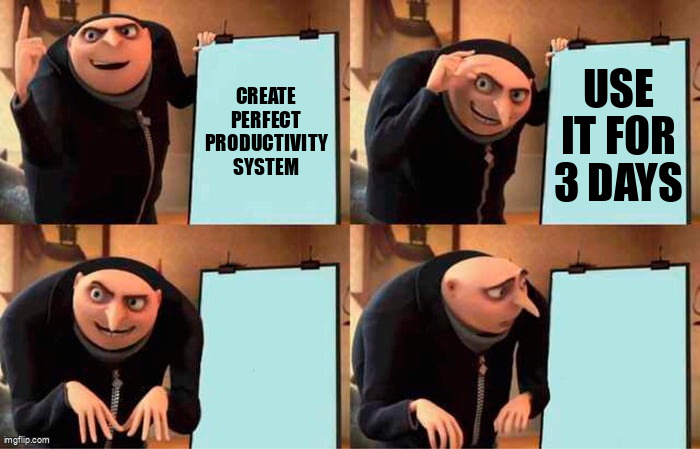
Yeah. We've all been there.
The Actual System: External Brain + Dopamine Drops + Forgiveness
Okay. Here's what actually works.
Your External Brain (the capture system)
You need exactly ONE place where thoughts go to not die.
Not five apps. Not a journal AND your phone AND sticky notes. One place.
I use a single running note on my phone called "Brain Dump" but you can use: - A small physical notebook you keep in your pocket - Voice memos (if you're more of a talker) - One specific notes app (I like Apple Notes or Google Keep because they're already on your phone)
The rule: when a thought happens, it goes there immediately. No organizing. No categorizing. No making it pretty.
"Buy cat food" goes right next to "existential dread about career" goes right next to "that thing Sarah said on Tuesday." All of it. No judgment.
This stops the "I'll remember this" lie we tell ourselves 400 times a day.
Dopamine Drops (the task system)
Here's where we get smart.
Every morning (or whenever you start your day, time is fake), you look at your Brain Dump and pick THREE things. Not 47. Three.
One MUST be tiny. Like "reply to that one email" tiny. Something you can do in under 5 minutes.
Why? Because you need a win. Your brain needs proof that you can do things today. Dr. Barkley on external scaffolding for ADHD explains how these small external structures create the momentum our brains can't generate internally.
One should be medium. 20-30 minutes. Something that moves a project forward.
One can be your "if I have the energy" task. The thing you'd love to do but won't beat yourself up about if it doesn't happen.
Write these three things on a Post-it note. Physical. Where you can see it.

When you finish one, you get to dramatically cross it off. This is not optional. The crossing off is PART of the system. That's your dopamine hit.
The Forgiveness Layer (the thing that makes it sustainable)
This is the part other systems never include: permission to be human.
Didn't finish all three things? The world didn't end. Move what matters to tomorrow's three. Let the rest go.
Had a day where you couldn't even look at the Post-it note? That's information about your capacity, not a moral failing. Try again tomorrow.
Used the system perfectly for a week and then forgot it existed for two months? Cool. Start again today. No shame spiral required.
The system isn't the boss of you. You're using it as a tool. Tools don't judge you when you put them down.
Power-Ups: What to Add When the Basics Are Working
Once you've got the core system running for a couple weeks (and it WILL fall apart and you WILL restart it, that's part of the process), you can add power-ups.
Body Doubling Lite
Even when you're alone, you can use body doubling to stay on task. I have a lofi music for focus sessions playlist going basically 24/7. It's not just background noise. It's an external anchor that tells my brain "we're in work mode now."
My Lofi Cutie YouTube channel has study-with-me sessions specifically for this. It's just cozy music and a timer. Nothing fancy. But having that external structure makes my brain behave.
The Hyperfocus Redirect
When you feel hyperfocus kicking in, you have about 30 seconds to aim it at something useful before it latches onto Wikipedia articles about deep-sea creatures.
Keep your three tasks visible. When you feel that focus energy, look at the Post-it. Pick one. Ride the wave while it lasts.
Working with hyperfocus, not against it, means having systems in place to catch it and redirect it. You can't summon hyperfocus. But you can be ready when it shows up.
The Timer Trick
Set a timer for 10 minutes. Tell yourself you only have to work for 10 minutes.
This is not the Pomodoro Technique (which assumes you can do 25-minute intervals, lol). This is permission to stop after 10 minutes if you want to.
90% of the time, starting is the hard part. Once you're 10 minutes in, you'll keep going. But you don't have to. That's the trick.
Visual Progress Tracking
Get a paper calendar. Every day you look at your Brain Dump and pick your three things, put an X on that day.
You're not tracking completion. You're tracking engagement with the system.
Some days you'll do all three tasks. Some days you'll do none. But if you at least LOOKED at the system and picked three things? That's an X.
Watch the chain of X's grow. Don't break the chain becomes way more motivating than "don't break your perfect productivity record."
What This Looks Like in Real Life
Let me show you what a week actually looks like with this system.
Monday: Brain Dump has 23 items. I pick three: "email dentist" (tiny), "write outline for blog post" (medium), "finally organize photos from 2019" (aspirational). I do the email immediately. Write half the outline. Never touch the photos. That's a win.
Tuesday: Move "finish outline" to today's three. Add "grocery pickup" (tiny) and "research that thing for work" (medium). Finish all three because I slept well and had coffee. Feel like a productivity god.
Wednesday: Forget the system exists until 3pm. Finally look at Brain Dump. Pick three things. Do one. Whatever. It's fine.
Thursday: Back on track. Three things. Timer trick for the medium task. Use body doubling (my own YouTube video playing) for the focused work. Hyperfocus shows up randomly and I finish two days of work in 90 minutes. This is unsustainable and I will pay for it tomorrow.
Friday: Pay for Thursday. Can barely think. Pick three tiny things only. Do two. That's actually perfect.
See? It's messy. It's inconsistent. It works anyway.
ADDitude's guide to ADHD-friendly systems has more app-based options if you want to try digital tools. But start with the basics first. App graveyard is real.
The Bottom Line
You don't need a perfect system. You need one that survives contact with your actual life.
The ADHD productivity system that works is the one you'll actually use on your medium days. Not the one that only works when you're firing on all cylinders.
Brain Dump everything. Pick three things. Do what you can. Forgive what you can't. Repeat.
That's it. That's the whole system.
We've got a whole channel in The ADHD Nest Discord where people share their three things every day. It's just accountability without judgment. Come try it with us. [https://join.adhdnest.org/]
Your Turn 🪴
What's one productivity "rule" that you've completely thrown out because it just doesn't work for your ADHD brain? I want to hear your rebellions!