Why Time Always Sneaks Up on You With ADHD
ADHD time estimation is broken for most of us. Here's why "just leave earlier" doesn't work, and what actually helps when your brain can't feel time.

ADHD Time Estimation: Why You're Always Late (And What Actually Helps)
Listen to this post
Hit play and do your thing. Ara reads it to you.
You tell yourself it takes 10 minutes to get ready. You believe this every single time. It actually takes 45 minutes, and you're genuinely shocked when you're late again.
Welcome to ADHD time estimation, where your brain is confidently wrong about how long literally everything takes. Not because you're careless or lazy. Because ADHD time blindness makes it almost impossible to feel time passing or accurately predict how long tasks will take.

And before anyone says "just add buffer time" or "leave 15 minutes early," cool cool cool. That assumes we can accurately estimate the thing we need to add buffer time TO. It's like telling someone who can't see the colour blue to just look harder.
Why ADHD Brains Are Terrible at Time Estimation 🧠
According to research from ADDitude Magazine, ADHD brains struggle with what's called "temporal processing." That's the fancy term for your brain's ability to feel time passing and make predictions about duration.
Most people have an internal clock that kind of works. It's not perfect, but it gives them a rough sense of "this will take about 20 minutes" or "I've been doing this for an hour."
ADHD brains? That clock is more like a Magic 8 Ball. Ask it how long something takes, and it confidently replies "Reply hazy, try again."
Here's what actually happens in our heads:
We compress time. Getting ready feels like it takes 5 minutes because we're only counting the actual actions (brush teeth, grab keys, put on shoes), not the transitions between them. Not the part where we stand in front of the closet for 4 minutes deciding on an outfit. Not the part where we realize we don't know where our keys are and spend 6 minutes searching.
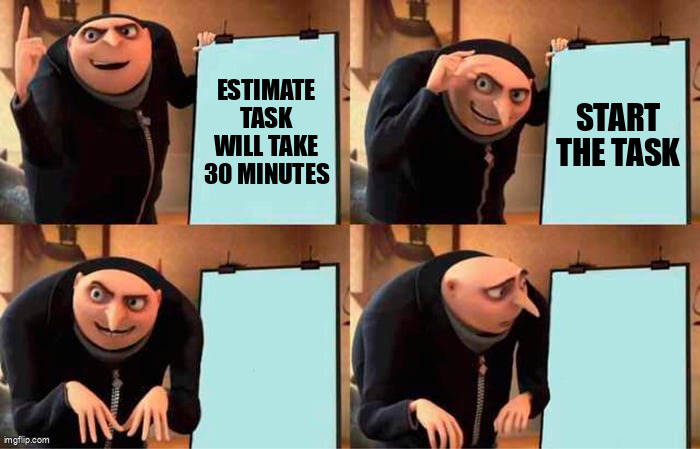
We underestimate everything. CHADD research shows that adults with ADHD consistently underestimate task duration by 30 to 40%. We think the grocery store run takes 15 minutes. It takes 40. Every time. And we're surprised every time.
We're optimists about the future. Future You is going to be SO efficient and focused. Future You doesn't get distracted. Future You definitely won't spend 10 minutes staring into the fridge. Current You bases all time estimates on this mythical productive version of yourself who.. does not actually exist.
We can't feel time passing while we're doing things. This is the core of it. When we're focused on something, time disappears completely. When we're bored, five minutes feels like an hour. There's no middle ground, no consistent sense of duration.
The "Just Set Alarms" Problem ⏰
Everyone loves suggesting alarms. And look, alarms CAN help. But they don't fix the root problem.
Because here's what actually happens: You set an alarm for "leave in 20 minutes." Great. But you still think you have time to do three more things before that alarm goes off. You think those three things take 5 minutes total. They take 18 minutes. The alarm goes off while you're mid-task, and now you're leaving without your lunch, your charger, or your sanity.
The alarm didn't fail. Your time estimation of what you could fit BEFORE the alarm was still broken.
Understood.org calls this the "planning fallacy," and ADHD brains are especially vulnerable to it. We genuinely believe we can shower, make breakfast, find that one shirt, answer three texts, and leave the house in 15 minutes.
The alarm can tell you when to leave. It can't tell you when to START getting ready. And that's the part we get wrong.

What Actually Helps With ADHD Time Estimation 💡
Okay, so if our internal clocks are busted and alarms aren't enough, what DO we do?
Track how long things ACTUALLY take. I know. I know. This sounds boring and tedious and like something a productivity bro would suggest. But here's the thing: you only have to do it once per task.
Time yourself getting ready. Actually track it with a timer. Not what you THINK it takes. What it ACTUALLY takes from "alarm goes off" to "walking out the door." Write it down. That number is now your reality anchor.
Do this for your common tasks. Grocery shopping. Making dinner. Your morning routine. Showering. Commuting. The actual numbers are always higher than what we think, and seeing them written down makes them harder to argue with.
Build in "stupid time." This is what I call the buffer for all the things we forget to count. The time it takes to find your keys. The time you spend standing in the kitchen trying to remember what you came in there for. The detours and distractions and tiny tasks that pop up.
Add 50% to whatever you think something takes. Not 10%. Not 20%. Fifty. If you think getting ready takes 20 minutes, block out 30. It feels like overkill until you realize you're actually on time.
Use external time anchors. Instead of "I need to leave in 20 minutes," use "I need to leave when this 25 minute focus session ends." Instead of "this task takes 30 minutes," use "this task takes one full pomodoro timer."
Let the external thing be the clock. Your brain doesn't have to estimate. It just has to follow along.
🎵 Lofi Cutie — Deep Focus Playlist · Updated regularly · Open in YouTube
Work backward from the deadline. If you need to be somewhere at 2pm, don't ask "when should I leave?" Ask "what time do I need to start getting ready to leave on time?"
If it takes 20 minutes to drive there, you need to leave at 1:40. If it takes 30 minutes to get ready to leave, you need to start getting ready at 1:10. Add stupid time? You actually need to start at 12:55.
Write that number down. The START time is the one that matters.
Do the thing that people with functioning time perception do. Leave earlier than you think you need to. I'm serious. Arrive places 10 minutes early. Bring a book, bring your phone, bring something to do while you wait.
Because here's the secret: being early feels weird for like 90 seconds, and then it's fine. Being late feels terrible the entire time and usually has consequences.
The Emotional Part Nobody Talks About 💜
Here's what makes ADHD time estimation so hard: it's not just a logistics problem. It's an emotional one.
Every time we're late, we feel like a failure. Every time we underestimate a task and it takes three times longer than expected, we feel incompetent. Every time someone says "why didn't you just leave earlier," we feel misunderstood.
We've been told our whole lives that being on time is about respect and responsibility. That being late means we don't care. And that's not true, but we've internalized it anyway.
So now we're not just dealing with broken time estimation. We're dealing with shame about broken time estimation. We're dealing with the anxiety of knowing we might be late again. We're dealing with the exhaustion of working twice as hard to do something other people's brains just.. do.
And that makes it even harder. Because now we're estimating time while also managing the emotional load of our history with time. We're trying to be accurate while our brain is screaming "you're going to screw this up again."
You're not broken. Your brain just processes time differently. That's not a character flaw. That's neurology.
The accommodations you need to function aren't signs of weakness. They're signs you understand how your brain works and you're working WITH it instead of against it.
The Bottom Line
ADHD time estimation is hard because ADHD time blindness is real. Your brain genuinely can't feel time the way neurotypical brains do. You're not lazy, careless, or disrespectful. You're dealing with a brain that doesn't have an internal clock that works.
The strategies that help aren't about trying harder. They're about building external systems that your brain can actually use. Tracking real durations. Adding buffer time. Using timers and anchors. Working backward from deadlines.
It's okay if this feels like more work than it should be. It IS more work than it should be. But it's also better than the alternative, which is being late and feeling terrible about yourself forever.
We talk about this stuff all the time in The ADHD Nest Discord. Time blindness, strategies that actually work, and how to cope with the emotional weight of feeling like you're always behind. It's free, and you're not the only one figuring this out. https://join.adhdnest.org/
Your Turn 🪴
What has helped YOU with ADHD time estimation? Drop it in the comments. Every answer helps someone.