Time Tools That Actually Work for ADHD (No More Apps)
Most ADHD time management tools fail because they ignore time blindness. Here's what actually works when you can't feel time passing.


ADHD Time Management Tools That Actually Work (Not Another App)
Listen to this post
Hit play and do your thing. Ara reads it to you.
I have seventeen time management apps on my phone right now. Seventeen.
None of them are open. I couldn't tell you the last time I checked any of them. But I keep downloading new ones because surely THIS one will be the magical solution that makes me understand how time works.
Spoiler: it never is.
Here's the thing about ADHD time management tools. Most of them are designed for neurotypical brains that can feel time passing. They assume you'll naturally know when 30 minutes have gone by, or that you can estimate how long a task will take, or that a deadline three days away feels real.

When you have ADHD time blindness, those assumptions fall apart completely. Time doesn't feel linear. It's either NOW or NOT NOW. Everything takes "five minutes" until suddenly three hours have evaporated and you forgot to eat lunch.
So let's talk about tools that actually work when your brain can't feel time passing.
The Problem With Most ADHD Time Management Tools
Most productivity tools fail us because they're built on the assumption that time feels consistent.
A calendar tells you "meeting at 2pm" but 2pm doesn't feel different from 2:30pm until you're suddenly late. A to-do list says "Wednesday" but Wednesday feels infinitely far away until it's Wednesday at 11:47pm and you're panicking.
According to research on ADHD and time perception shared by ADDitude Magazine, people with ADHD struggle with prospective time estimation. We genuinely cannot accurately predict how long tasks will take. It's not laziness or poor planning. Our brains literally don't process time intervals the way neurotypical brains do.
This is why downloading another Pomodoro timer app doesn't fix anything. The tool isn't the problem. The tool is trying to solve a problem your brain experiences differently.
What we actually need are tools that make time VISIBLE and EXTERNAL, because we can't feel it internally.
Visual Timers (The Only Timer That Works)
Forget the timer on your phone. You know why? Because when time is invisible, it doesn't exist.
A visual timer shows you time melting away in real time. You can literally watch the red part shrink. Suddenly time has a shape. It has urgency that your brain can actually perceive.
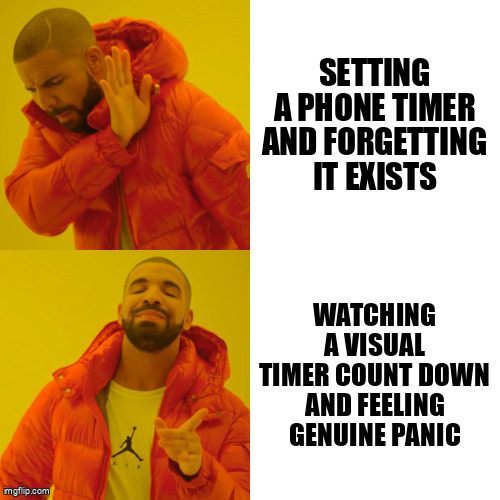
I use the Time Timer. It's a physical timer that costs around $25 and it sits on my desk where I can see it. The red disc disappears as time passes. When I can SEE that I only have ten minutes left, my brain actually believes it.
There are also app versions if physical objects stress you out. Time Timer has a decent app. Visual Timer is free and does the same thing. The key is that it needs to be VISIBLE while you work, not hidden behind other windows.
This is one of those tools that create real urgency when your brain can't generate urgency naturally.
Does it feel silly to need a literal countdown clock to know that time is passing? Maybe. Do I care? Not even a little. It works.
Body Doubling Apps (Because Accountability Makes Time Real)
You know what makes time feel real? Another human existing in the same space.
Body doubling is when you work alongside someone else, even if you're doing completely different tasks. Their presence creates external structure. Time suddenly has markers. If they're there, you're there. If they're working, you're working.
CHADD explains that external accountability is one of the most effective strategies for ADHD time management because it bypasses our internal executive function struggles. We don't have to generate motivation or time awareness ourselves. Someone else's presence does it for us.
Focusmate is the app I actually use for this. You book 25 or 50 minute sessions with a random person. You both turn on your cameras, say what you're working on, then work silently together. At the end you check in. That's it.
It sounds weird until you try it. Then it's magic.
Suddenly those 25 minutes are REAL because another person is experiencing them with you. You can't just drift off into scrolling because someone would see. The session has a beginning and an end. Time has boundaries again.
Other options: Flow Club does virtual coworking rooms. Cave Day runs longer group sessions. Or honestly? Just FaceTime a friend and work silently together. The tool doesn't matter. The presence does.
I also run body doubling sessions on my YouTube channel sometimes. Lo-fi beats, a timer on screen, and the knowledge that other ADHD brains are working alongside you through the video. It's the same concept. You're not alone in time anymore.
Time Blocking With Alarms (Not Reminders)
Here's where most time management advice tells you to "block your calendar" and then assumes that will mean something to your brain.
It won't. A calendar block is invisible. It's a suggestion. Your brain will ignore it completely.
What DOES work? Alarms. Loud ones. Multiple ones.

I don't set reminders. Reminders are polite little notifications that I swipe away without processing. Alarms are RUDE. They interrupt. They demand attention. They won't stop until you physically interact with them.
For time blocking to work with ADHD, every block needs an alarm. One alarm when the block starts. Another alarm five minutes before it ends. Maybe even one in the middle if it's a long block.
This is how I make transitions happen. My brain doesn't naturally register "okay, work time is over, now it's lunch time." But an alarm screaming at me? That I notice.
I use different alarm sounds for different types of blocks. Gentle chime for focus time starting. Slightly more aggressive buzz for "you need to leave for that appointment RIGHT NOW." Genuinely annoying siren sound for "take your medication or you'll forget."
Is this intense? Yes. Does it work? Also yes.
According to Understood.org, people with ADHD benefit from external cues and environmental supports because our internal sense of time and priority is unreliable. Alarms are external cues that our brains can't ignore.
The Low-Tech MVP: A Physical Clock You Can See
Sometimes the best ADHD time management tool is just.. a clock. A real one. That you can see without having to pull out your phone.
I put an analog clock on the wall directly in my line of sight when I'm at my desk. Not digital. Analog. Because seeing the hands move gives me a better sense of time passing than numbers changing.
When I glance up and see it's 2:15, then look again and it's 2:47, I can SEE that time moved. The hour hand shifted. That registers in my brain in a way that "2:15" becoming "2:47" on a digital clock doesn't.
Bonus: a clock on the wall means I'm not checking my phone for the time and then accidentally falling into a 30-minute scroll hole. Win-win.
What Doesn't Work (So You Can Stop Trying)
Let's be honest about what fails us so you can stop feeling broken when these tools don't work:
Habit tracking apps. They assume consistency is possible. It's not. One missed day becomes guilt becomes abandoning the app entirely.
Complex scheduling systems. If the tool requires more than two steps to use, you won't use it. Your brain will choose chaos over complexity every time.
"Just write it down" advice. Writing something down doesn't make time real. It makes a list. Lists don't create urgency or time awareness.
Gentle reminder notifications. Your brain has already learned to ignore these. They have no power here.
The perfect productivity system. There isn't one. Any tool that promises to "fix" your ADHD time management is lying. What works is external structure that matches how your brain actually functions.
The Bottom Line
ADHD time management tools only work when they make time external, visible, and impossible to ignore.
Your brain isn't broken for needing this. It's just wired to experience time differently. Tools designed for neurotypical time perception will never work for you, and that's not your fault.
Find the tools that create external structure. Visual timers. Body doubling. Alarms that won't shut up. Analog clocks you can actually see. Whatever makes time REAL for your brain instead of abstract.
This is literally what The ADHD Nest Discord is for. We have a whole accountability channel where people post what they're working on and check in throughout the day. Body doubling through text. It's free and you're welcome there. https://join.adhdnest.org/
Time might not feel real. But community does.
Your Turn 🪴
What has helped YOU with ADHD time management tools? Drop it in the comments. Every answer helps someone.