How Virtual Body Doubling Helps Your ADHD Brain Stay on Track
Need body doubling but don't have anyone nearby? Here's how virtual coworking works, where to find free communities, and what actually helps ADHD brains focus together online.


Virtual Body Doubling: How to Find Your Perfect Online Focus Buddy
Listen to this post
Hit play and do your thing. Ara reads it to you.
I just spent 90 minutes organizing my entire sock drawer instead of answering three emails.
You know what finally got me to actually open my inbox? Hopping on a video call with a stranger from the internet who was also avoiding their own work. We didn't talk. We barely looked at each other. But somehow, just knowing someone else was there made my brain go "okay fine, I guess we're doing this now."
That's virtual body doubling. And if you've been struggling to focus alone but don't have anyone nearby to work with, this might be exactly what you need.

What Makes Virtual Body Doubling Different (and Why It Actually Works)
If you're new to this whole concept, what body doubling is and why it works is pretty wild from a neuroscience perspective. The short version: ADHD brains struggle with task initiation when we're alone, but the presence of another person doing their own work creates just enough external structure to help us actually start.
Virtual body doubling takes that same principle and moves it online.
You join a video call, camera on, and work alongside someone else. They're doing their thing. You're doing yours. Nobody's checking your work or judging your process. The magic is just in the parallel presence.
And here's the thing that surprised me: it works BETTER for a lot of ADHD folks than in-person body doubling. There's less social pressure, fewer distractions, and you can bail without it being weird if you need a break. You're accountable enough to stay on track, but not so watched that you freeze up.
The Best Virtual Body Doubling Platforms (Free and Paid)
I've tried basically all of them at this point. Some while genuinely trying to be productive, others while "researching" (read: procrastinating on actual work by testing productivity tools). Here's what actually landed.
Focusmate is probably the most popular option, and for good reason. Focusmate virtual coworking pairs you with a random person for 50-minute sessions. You both share what you're working on at the start, work in silence, then check in briefly at the end. It's structured enough to keep you honest but loose enough to not feel like surveillance. Free tier gives you three sessions a week, paid unlocks unlimited.
Flow Club takes a slightly different approach. Flow Club body doubling runs facilitated group sessions with a host who guides you through the session and occasional quick check-ins. It feels more like a gentle group accountability thing than solo parallel work. Some people love the extra structure. Others (me) find the check-ins distracting. They have a free trial so you can test if it vibes with your brain.
Study Together and similar YouTube live streams are body doubling lite, but they work surprisingly well if you're not ready for the commitment of a scheduled video call. My own channel (yeah, I'm biased, but hear me out) has 24/7 lofi streams where people literally just.. exist in the chat while they work. There's something weirdly comforting about seeing "still here, 2 hours in, send help" messages from other ADHD brains in the trenches with you.

And then there's our free body doubling community in The ADHD Nest Discord. We have dedicated co-working voice channels where people drop in whenever they need to get something done. Zero pressure, zero scheduling, just "hey I'm working on a thing if anyone wants to join." Sometimes it's two people, sometimes it's twelve. It's genuinely the most low-key, ADHD-friendly version I've found.
How to Actually Make Virtual Body Doubling Work (When Your Brain Fights You)
Okay so you've picked a platform. You've blocked out time. And then the appointment arrives and suddenly every part of your brain is screaming to do literally anything else.
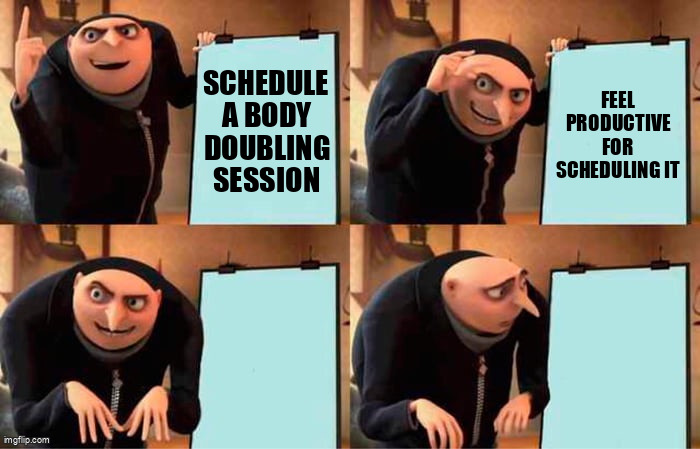
Yeah. That's the ADHD tax nobody tells you about with virtual body doubling.
Here's what actually helps me show up:
Set it and forget it. Book your sessions for the same time every day or week. Don't make it a decision every single time or you'll decision-fatigue yourself out of doing it. I have Focusmate sessions auto-booked for 10am every weekday. Some days I cancel. Most days I show up because it's just.. there.
Pair it with something your brain already wants. I make good coffee right before my morning session. My brain has learned: body doubling time equals good coffee time. Classical conditioning, but make it ADHD. Find your version. (Related: lofi music for focus sessions is my other pre-session ritual that signals to my brain "okay we're doing the focus thing now.")
Start with absurdly low stakes. Your first session doesn't have to be "write entire dissertation." Make it "open the document." That's it. You can stare at a blank page for 25 minutes if you want. The point is showing up and letting your brain learn that this is a safe, doable thing.
Have a backup plan for when you can't people. Some days, camera-on video calls feel like asking me to run a marathon. On those days, I'll use a YouTube study stream or just post in our Discord co-working channel that I'm working and check in every 30 minutes. Still body doubling. Just.. gentler.
And if you're someone who needs more structure than just "show up and work," combining virtual body doubling with ADHD-friendly productivity systems like time blocking or the Pomodoro technique can help. The body doubling handles the activation energy problem. The system handles the "wait what was I supposed to be doing" problem.
What the Research Actually Says About Virtual Body Doubling
There's not a ton of formal research on virtual body doubling specifically yet, but ADHD-specific body doubling research from ADDitude Magazine shows that the core mechanism works whether you're in the same room or on a screen. The key factor is perceived presence, not physical proximity.
Your ADHD brain doesn't care if your body double is sitting next to you or beaming in through a screen. It just needs to feel like someone else is in the "doing tasks" mode with you. That external anchor is enough to help with task initiation, sustained attention, and actually finishing things instead of tab-hopping into oblivion.
The bonus with virtual options: you can find body doubling partners who are actually working on similar tasks, or who have compatible working styles, or who are also neurodivergent and get why you need to stand up and pace every seven minutes. Geography doesn't limit you anymore.

When Virtual Body Doubling Doesn't Work (and What to Try Instead)
Real talk: virtual body doubling is not a magic bullet.
If you have serious executive function challenges around even opening your laptop, body doubling alone might not be enough. You might need external scaffolding first, like an accountability text from a friend, or a reward system, or honestly just.. someone to physically hand you your laptop and say "open it."
If you have social anxiety that makes camera-on sessions feel like a nightmare, start with camera-optional spaces. Our Discord co-working channels don't require video. You just exist in voice chat. Some people don't even unmute. It still works.
And if you're in a phase where literally any human presence feels like too much, that's valid too. Sometimes you need to work in your blanket cocoon with no witnesses. That's fine. Body doubling is a tool, not a moral obligation.
I literally have this playing on repeat while I write. It's my secret weapon:
🎵 Lofi Cutie — Deep Focus Playlist · Updated regularly · Open in YouTube
Use what works when it works. Drop what doesn't. ADHD brains are allowed to be inconsistent. That's kind of our whole thing.
The Bottom Line
Virtual body doubling isn't about forcing yourself to perform for strangers on the internet. It's about borrowing someone else's momentum when your brain won't generate its own.
Some days that looks like a structured Focusmate session. Other days it's lurking in a YouTube chat while lofi beats play. Sometimes it's just knowing other people are in the Discord co-working channel even if you're not talking.
The point is: you don't have to do hard things alone anymore. There are literally thousands of ADHD brains out there right now, also avoiding their tasks, also needing a gentle push. Find them. Work next to them. Help each other get the thing done.
This is literally what The ADHD Nest Discord is for. Come try co-working with us. It's free and genuinely one of the most supportive spaces I've ever been part of: https://join.adhdnest.org/
Your Turn 🪴
Have you tried virtual body doubling yet? What platform or setup works best for you, or are you still looking for the right fit? Drop your recommendations below!